

Before I became a writer, I was a reader. I was weaned on the classics like Ray Bradbury, Isaac Asimov, and Arthur C. Clarke. Yeah, I know. My age is showing. But my point is there were so many great adventures, and all of them were built on exceptional writing. Then I broadened my horizons by exploring new and often unknown authors. Was the experience as good as the masters? Ehh, sometimes, but not always.
I hoped for my beloved immersive journey, but when that experience was interrupted, it was almost always grammar mistakes, misspelled words, careless typos, and the wrong verb tense. Such mistakes jolt a reader out of suspension of disbelief. These mistakes and others like them are avoidable.
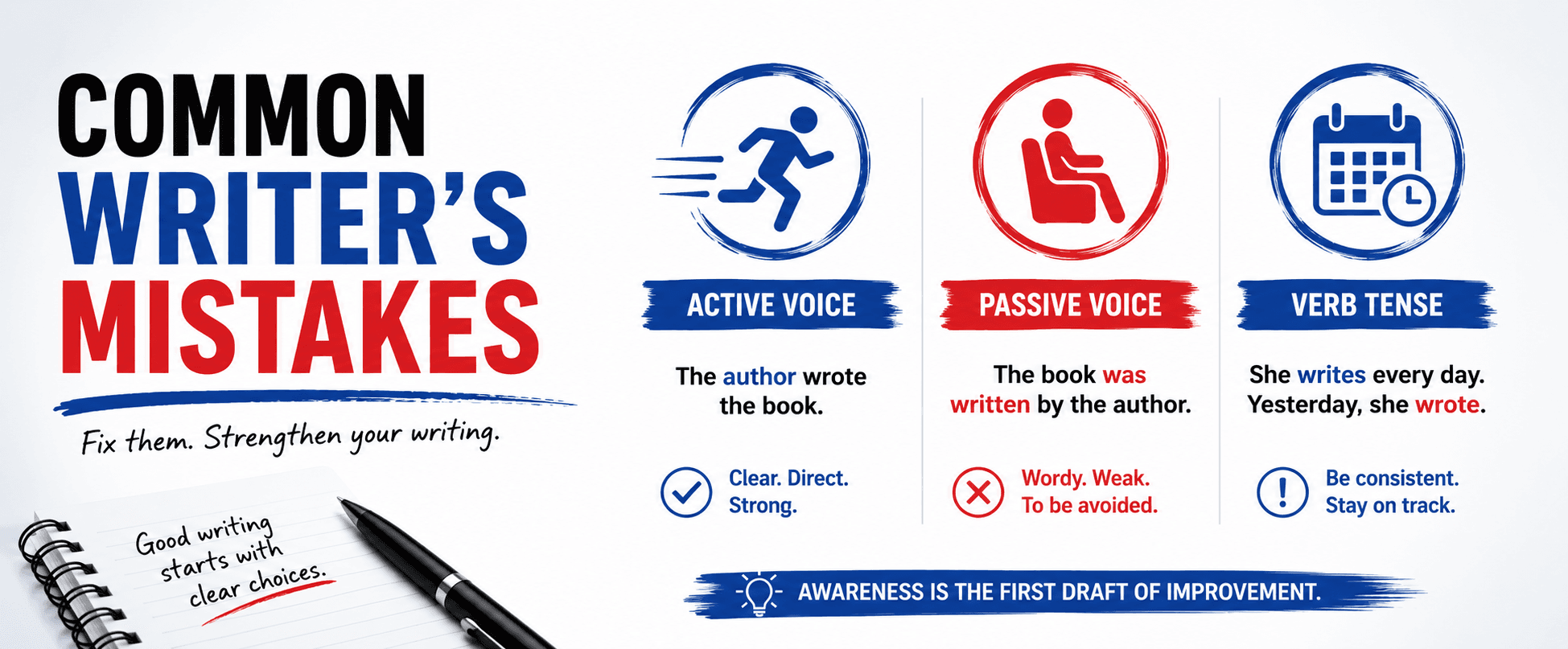
In this video, we'll take a look at three of the most common mistakes writers make: active voice, passive voice, and verb tense.
Using a VPN and seeing an error?
Click here to open and watch directly on YouTube.
Video Transcript:
Hello, I’m TJ Culler, and today let’s talk about three things that quietly sabotage otherwise good writing: Active voice. Passive voice. And verb tense.
Most writers never think about these until an editor hands their manuscript back with red ink all over it.
These aren’t just grammar rules for grammar nerds. They’re the difference between writing that moves and writing that sits there waiting for something to happen.
Here’s the short version. Active voice commands! Passive voice apologizes.
Active voice is direct. It’s confident. It tells the reader exactly what’s happening and who’s doing it. Passive voice hedges. It shuffles its feet. It leaves the reader doing extra work to figure out what’s actually going on.
The Chicago Manual of Style puts it plainly — it calls passive constructions “roundabout” and notes that the active voice is “usually more natural and direct.” Usually. Chicago likes its qualifiers. But the point stands.”
So what does this actually look like on the page?
Let’s consider an example.
Passive voice says: The door was closed by the detective. While active voice says: The detective closed the door.
Same information. Completely different energy. The passive version makes you wade through the action to find out who did it. The active version puts the detective front and center, where he belongs.
Here’s another example.
Passive voice says: Mistakes were made during the investigation. And active voice says: The detective made mistakes during the investigation.
Notice what the passive voice does — it floats the mistake in the air with no one attached to it. It’s the grammatical equivalent of a shrug. Mistakes were made. By whom? By the universe, apparently.
That’s the other problem with passive voice. It can obscure accountability. In fiction, that reads as evasive. In nonfiction, it reads as cowardly.
Now, here’s something writers do that’s a close cousin to passive voice — and it’s just as muddy.
Phrases like “we want to ensure our readers feel engaged” or “I hope to convey the urgency of the situation.”
You want to? You hope to? That doesn’t tell me what’s happening. It tells me what you’d like to happen — which is a very different thing. Either it’s happening on the page, or it isn’t. Wishing for it in your prose doesn’t make it so.
So in summary, active voice names who does what. It’s clean, confident, and easy to follow. Passive voice buries the actor, softens the action, and makes your writing feel uncertain — even when you’re not.
Here’s a writing tip: When you finish a scene or a paragraph, scan for any form of the verb to be followed by a past participle — was taken, were seen, had been told. That’s your passive construction. Ask yourself: who’s doing this? Then put that person at the front of the sentence. Nine times out of ten, your writing gets better immediately.
Alright—Now let’s talk verb tense. This one is less about style and more about consistency — and it’s one of the most common errors book editors flag in fiction manuscripts.
The Chicago Manual of Style dedicates substantial guidance to tense, noting that in narrative fiction, the past tense is the “traditional” choice — and that whatever tense you choose, consistency is essential. The moment you start drifting between tenses without intention, readers feel it. They might not know why the passage feels off, but they’ll feel it.
Here’s what it looks like in practice.
Let’s consider an example of a tense drift:
Sarah crossed the room and stops at the window. She stared outside at the empty street.
Did you catch it? Crossed and stared are past tense. Stops wandered in from the present tense and didn’t knock first. One word, and suddenly the reader is pulled out of the story to do a double-take. That’s the opposite of immersive.
The next example has a more subtle shift:
He had spent years rebuilding after the fire. He learns, eventually, that trust doesn’t come back the same way it left.
The first sentence is past perfect — fine for backstory. But then learns shows up in the present tense, like it belongs in a different book. The writer probably shifted because they were making a universal observation, and present tense feels right for those. But in a past-tense narrative, you need to stay in the lane. Rewrite it: He learned, eventually, that trust doesn’t come back the same way it left. Done.
Tense shifts break the reader’s sense of time in the story. A single rogue verb is enough to do it. The fix isn’t complicated — it just requires attention.
Pick your tense, commit to it, and do a dedicated pass specifically hunting for inconsistencies. Don’t rely on catching them while you’re editing for other things. Your brain will fill in what it expects to see. Give tense its own read-through. You’ll be surprised how many stowaways you find.
So. Active voice keeps your writing sharp and accountable. Consistent verb tense keeps your reader oriented. Neither one is glamorous. But get both right, and your prose gets out of its own way — which is really all good writing is trying to do.
‘Till next time. I’m TJ Culler. And as we say at The Author Spot, “Go on and write. We’ll handle the tech.”
“Till next time – TJ
 |
TJ Culler is an author, reader, and an adventurist. She loves working at The Author Spot as an Author Platform Specialist. Her hobbies include hiking, camping, and driving her Jeep in the great outdoors. After publishing her first book in 2017, TJ discovered what a daunting task an author platform really was. She now dedicates her time to helping authors who struggle with technology. |









Recent Comments