

Here at The Author Spot, we often describe our services as solutions for technology-challenged authors. Over the years, we realized that authors are not necessarily computer geeks, and vise versa. We at The Author Spot, however, collectively have over 45 years of tech experience, and while we are also authors, at our core is a mastery of technology.
In this post, we take a close look at domain names. Admittedly not the sexiest topic, but very important to all authors. If you ever need help navigating such obstacles, our expertise is a simple text message away.
Using a VPN and seeing an error?
Click here to open and watch directly on YouTube.
Video Transcript:
Intro:
In previous videos, we’ve examined grammar and writing techniques, but today we’re focusing on technology. Specifically, domain names. If you’re an author, you already know you need one, maybe more than one.
But, where do domains names come from? Do they appear all on their own? Hardly! There are several choices you have to make when acquiring a domain name, and not all of them are easy. In this video, we’ll consider domain name choices and how they can be a wise choice, or a seriously stupid one.
Choosing Your Domain Name
Let’s begin with choosing your domain name.
Your domain name is your address on the internet. And like a physical address, you want it to be easy to find — not something people have to spell three times before they give up and Google somebody else.
So rule number one: keep it simple and memorable. That means no weird spellings, no hyphens, no numbers crammed in the middle. If you have to say “it’s Author Jane — but with a hyphen between Author and Jane, and the number 2 at the end” — you’ve already lost them. A domain should roll off the tongue the first time, not after a five-minute customer support call.
Here’s a quick gut-check I like: can you say it out loud over the phone without spelling it out? If the answer is no, keep looking.
Now think long-term. That clever, trendy domain that feels so fresh right now? Give it five years. Does it still make sense? Your domain is going to be on business cards, in email signatures, and embedded in SEO for years. You want something that still works when you’re promoting your tenth book, not just your first.
And please — before you pull out your credit card — check for trademark conflicts. Just because a domain is available doesn’t mean the name is legally safe to use. A quick trademark search can save you from a very unpleasant letter from someone’s attorney.
Domain Privacy Protection
Now let’s consider Domain Privacy Protection.
Here’s something most people don’t realize when they register a domain. When you register, your name, address, phone number, and email can become publicly visible in what’s called the “WHO IS” database. It’s basically a public directory of who owns what domain.
And yes, people look at it. Usually people you don’t want looking at it.
Most registrars offer something called “WHO IS” privacy protection — sometimes called domain privacy or private registration. It’s often just a few dollars a year, and it replaces your personal information in that public record with the registrar’s contact details instead.
Turn it on. It won’t make you invisible, but it will dramatically cut down on spam, robocalls, and those fun phishing emails that pretend to be your hosting company. Trust me, your inbox will thank you.
Renewal Mistakes
Now let’s talk about one of the most painful — and completely avoidable — mistakes authors make.
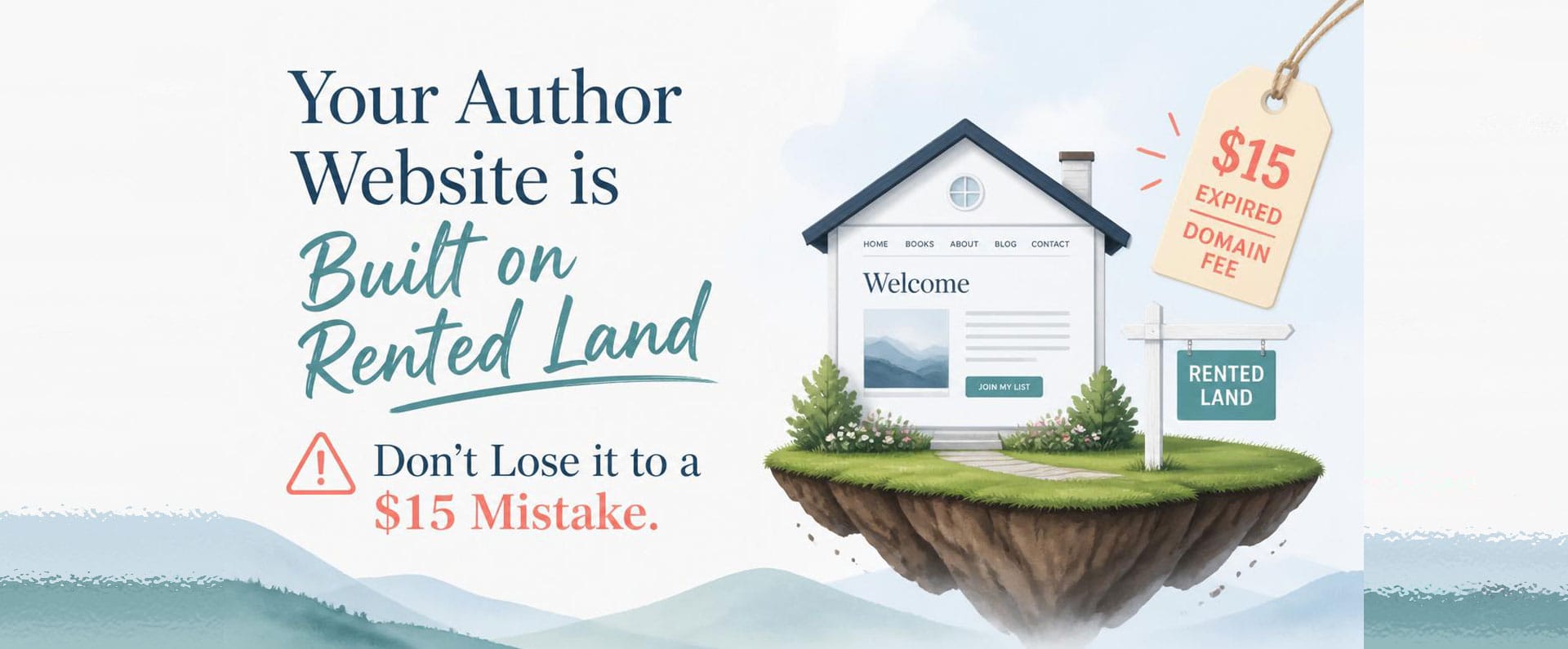
You don’t own your domain name. You rent it. Every year, or every few years if you pay ahead, that registration has to be renewed. Miss the renewal window, and the domain expires. And once it expires? Someone else can register it. Your brand, your website, your years of SEO — gone. Sometimes within hours.
I’ve seen this happen. It’s not pretty.
The fix is almost embarrassingly simple: turn on auto-renew. Every reputable registrar offers it. Set it, confirm your payment method is current, and forget about it. One forgotten renewal can destroy years of branding and SEO. Auto-renew costs you nothing extra and saves you from that nightmare.
One more thing on this — and I want you to remember this part specifically. If your hosting company registers the domain for you, they may control access to it, which makes transfers and management much harder down the road. And if that hosting company ever goes out of business? Recovering your domain can become a long, painful process with no guarantee of success.
Register your domain yourself, through your own account, at a dedicated registrar. This is precisely what we can help you do at The Author Spot.
Security
Any conversation about domain names is incomplete without a word on security.
Domain theft is rare. But it happens. And when it does, getting your domain back is a bureaucratic nightmare that can take weeks or months.
The best defense is also the simplest: enable two-factor authentication — 2FA — on your domain registrar account. That means even if someone gets your password, they still can’t get in without that second verification step.
Most registrars support 2FA through an authenticator app or SMS. Use the authenticator app if you can — it’s more secure. Set it up today. This takes about five minutes.
While you’re in there, make sure your contact information is current. Your email address especially. Because if you ever need to recover access to your domain, the registrar is going to send a verification link to that email on file. If that email address no longer exists — if it’s an old work account, a forgotten inbox, anything like that — you could find yourself locked out of your own domain with no easy way back in.
Current email. 2FA. Done.
Purchasing Multiple Domains
Okay. You’ve got your main domain locked in. Great. Now let’s talk about whether you should grab a few more.
This is called defensive registration, and it’s more common than you might think. The idea is simple: buy the common misspellings of your name or book title before someone else does — or before a spam site does. Even if you “park” a domain, that means registered but not used, it’s worth it if it prevents customer confusion.
Also worth considering are variations of spelling. You’d be surprised, or not, how many people search with incorrectly spelled search words. It’s amazing Google can deliver anything at all.
For authors specifically, I’d recommend thinking through a short list:
- Your author name dot com
- Your author name dot net as a backup
- Your book title dot com if it’s available
- Your series name dot com if you’re writing a series
These don’t all need live websites. They can just redirect to your main site. But owning them means nobody else can use them to confuse your readers — or worse, cash in on your reputation.
Domain Extensions for Authors
A few years ago, TLDs or Top Level Domains were extended to include a broad selection of profession specific extensions. Now you’ve got more options than ever. Beyond the classic .com, there are now extensions built specifically for creators: .author, .books, .press, .media, .blog, .store, and .shop.
These can be genuinely useful for branding. myname.press has a certain professional ring to it. myname.store is pretty clear about what you’re selling.
But here’s the honest reality: .com is still the gold standard. It’s what people type by default. It’s what feels legitimate to most audiences. If you can get your name or your title as a .com, get that first.
Use the other extensions creatively — for a specific book launch, a newsletter, a podcast — but don’t let them replace your .com presence. Think of them as supporting players, not the lead.
Email Considerations
Now let’s consider domains with email. This is the one that surprises people most. A domain isn’t just an address for your website. It’s also the foundation of your professional email.
Think about the difference between these two email addresses: janedoe@gmail.com versus jane@janedoe.com. One looks like someone’s personal account. The other looks like a business. When you’re reaching out to a media contact, a publishing house, or a book club coordinator — you want to look like a business.
Some addresses worth setting up once you have your domain:
- author@yourdomain.com — your primary contact
- contact@yourdomain.com — for general inquiries
- media@yourdomain.com — specifically for press and interviews
You don’t have to check three inboxes. Most email services let you forward everything to one place. The point is that the address people see is professional.
Your domain can power your entire brand’s email system. Don’t leave that on the table.
Separate Your Assets
This one’s a bit more technical, but stay with me — it matters.
A lot of authors set up their websites through an all-in-one service that handles everything: the domain, the hosting, the email, the files. It feels convenient. And it is — right up until the moment something goes wrong.
Here’s the thing. When one provider controls everything, you have no leverage and no fallback. Want to move your website to a new host? Your domain is stuck there too. Service goes down? Everything goes down at once.
The smarter approach is to keep your assets separate:
- Your domain registration at a dedicated registrar
- Your hosting account somewhere else
- Your website files backed up independently
- Your email service potentially through its own provider
This isn’t complicated to set up, and it gives you flexibility. If your hosting company raises prices or has a bad service year, you can move the website without touching the domain. If your email provider goes down, your site still works. Each piece is independent.
Think of it like not keeping all your money in one bank.
Top 5 Domain Name Mistakes Authors Make
Alright, let’s do a quick lightning round. These are the five domain mistakes I see authors make most often.
Number one: Letting a host control their domain registration. We just talked about this. Own your domain separately. Always.
Number two: Forgetting to renew the domain. Auto-renew. Turn it on. Walk away.
Number three: Choosing a domain that’s hard to spell. If you have to spell it out when you say it, that’s a problem. Simplify.
Number four: Ignoring trademark conflicts. Available doesn’t mean legally safe. Do the check.
Number five: Failing to secure the registrar account with two-factor authentication. Five minutes of setup. Years of protection.
Avoid these five, and you’re already ahead of most.
Summary
You’ve heard me say this before — “Go on and write. We’ll handle the tech.” That is The Author Spot’s mission.
Domain names are exactly the kind of thing we mean when we say that. It’s not glamorous. Nobody sits down to write a novel and thinks, “I can’t wait to research domain registrars.” But get it wrong, and it can cost you your website, your email, your brand — sometimes overnight.
The good news is that getting it right isn’t complicated once you know what you’re doing. Pick something simple and lasting. Protect your privacy. Own your registration. Secure your account. Keep your assets separate. And for the love of Pete, turn on auto-renew.
That’s why we’re here — to take the tech confusion off your plate so you can focus on what actually matters. The writing.
Now go on and write, and we’ll handle the tech.
 |
TJ Culler is an author, reader, and an adventurist. She loves working at The Author Spot as an Author Platform Specialist. Her hobbies include hiking, camping, and driving her Jeep in the great outdoors. After publishing her first book in 2017, TJ discovered what a daunting task an author platform really was. She now dedicates her time to helping authors who struggle with technology. |









Recent Comments