

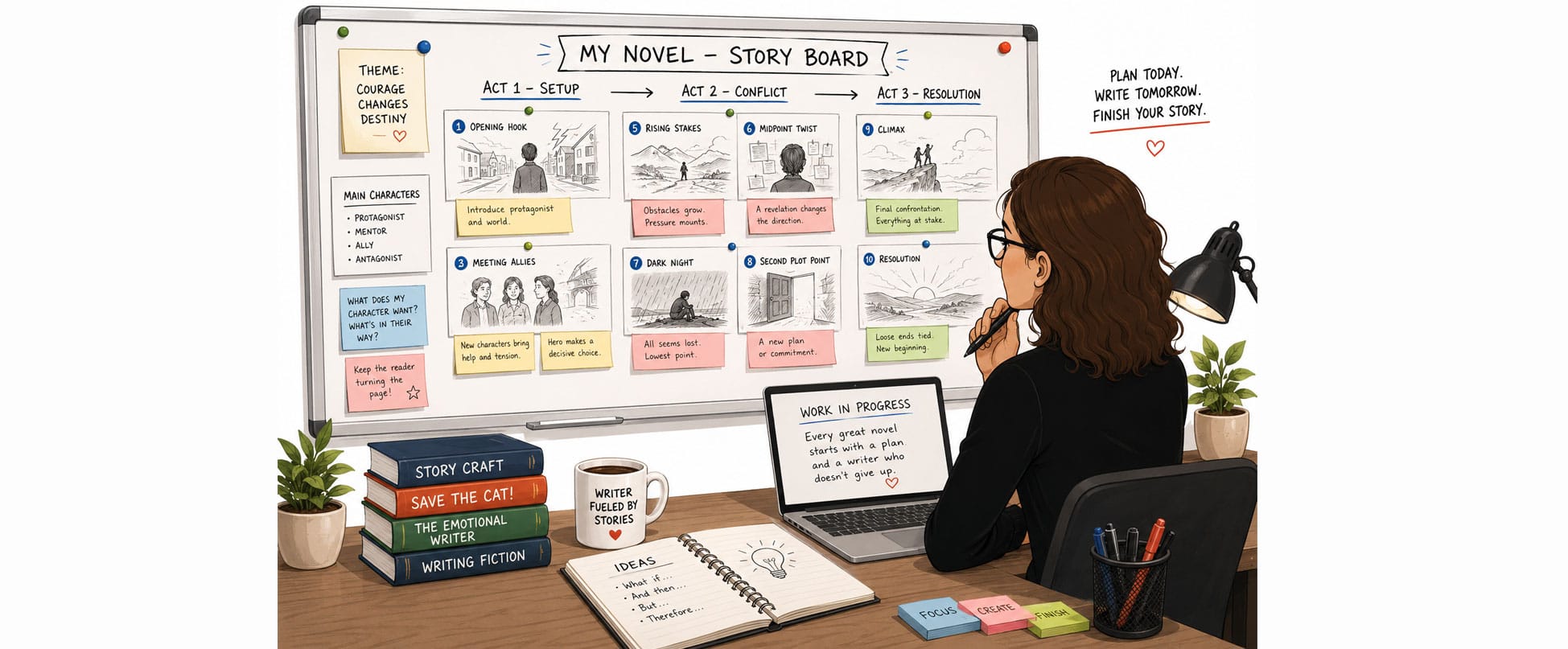
This is the blog post I couldn’t wait to write. The anticipation was making me wait. (Ooo, that sounds like a song). The post is about my upcoming novel, Escape From Duda’El. With each post, I will explore and share the process of finding inspiration, composing, designing, and finally publishing this novel.
In this episode, I share a bit of the backstory that planted the novel’s premise in my head, and how that lead me to launching The Author Spot.
Using a VPN and seeing an error?
Click here to open and watch directly on YouTube.
Video Transcript
Hey, My name is TJ Culler—and I’m the founder of The Author Spot. In previous episodes, I’ve discussed a variety of writing, grammar, and technology topics. But today, we’re going to take our first look at my upcoming novel, Escape From Duda’El.
I’ve been looking forward to sharing the details of this project with you for some time now. So, to kick off this series, let’s look at the inspirations that placed me on the novel-writing path, and how I literally stumbled into developing The Author Spot.
I can’t wait to share the details of this project with you. So, to kick off this series, I will share the inspirations that placed me on the novel-writing path, and how I literally stumbled into developing The Author Spot.
I love reading books. I love getting lost in a narrative, and I’m more than willing to suspend disbelief for a good tale. I even built a corner in my house just for reading—a wingback chair, a bridge-arm reading lamp, and an antique sewing cabinet doing double duty as storage for my ever-growing stack of I-can’t-wait-to-get-to books.
For years—decades, honestly—I waited for my favorite authors to write the book I wanted to read. Year after year, they didn’t deliver. Eventually I got tired of waiting, so I said, “Screw it, I’ll write it myself.”
The story I yearned for was forming in my head long before I ever put it into words. It started with an old 1980s sci-fi movie called Dreamscape. There’s a scene in it about lucid dreaming, and something about that idea just hooked me. I wanted more.
A few years later I watched Dream Warriors, an entry in the Nightmare on Elm Street franchise. The heroes learned to manipulate their dreams to fight back against Freddie. Another piece of the puzzle clicked into place.
By then I was writing little “dreamscape” scenes on paper, poking at what my protagonist might look like, and unable to keep my imagination contained. I still have some of those early pen-and-paper prose tucked away somewhere.
Then came another movie with a theme that blurred the line between fantasy and reality even further. That added definition, and suddenly, I could see the story. Characters. Conflict. Scenes playing out in my head like a Hollywood production only I could watch.
But seeing a story and writing one are two very different things. How was I supposed to get these people out of my head and onto a page? The task felt enormous, and I felt so tiny beside it.
I needed tools. I needed something to map out the overlapping arcs I saw in my mind. How could I get them on paper? That’s how I found Scrivener and Scapple. I’ll share more on those software apps in a different post.
Discipline came next. I started getting up two hours early every single morning, parking myself at my keyboard with a cup of steaming espresso. I’d stare at the screen until I could see into each character’s soul—until I knew what they were thinking and could hear them talking. Then I’d get out of the way and let them move from my mind to the page.
It took me four years to pull these people out of my head—one paragraph at a time. And somewhere along the way, something strange happened—I fell in love with them.
My writing changed after that. I wasn’t writing a story anymore. I was taking dictation while my characters told me what to say. How I could hear different voices, each explaining their unique point-of-view still blows my mind when I think about it.
When the manuscript was finally done, I looked ahead to the next mountain—something people kept calling an “author platform.” Apparently that meant a whole pile of geeky work. Lucky for me, I’m the biggest geek this side of the Rockies, so whatever an author platform was, it was right up my alley.
I set up my own server. Then my own website. Then, because apparently I hadn’t given myself enough to do, I built my own cloud running on my server, and I called it The Author Spot.
From there I added an e-store stocked with my print books, audiobooks, and ebooks. Then a blog. Then instructional videos. Somewhere in the middle of all that, it hit me—I hadn’t just built something for myself. I’d built something other authors could actually use.
I’m not out to replace the big online marketplaces. They do plenty of good for plenty of authors. But for the writers who freeze up at the words “author platform,” for the authors who’d rather wrestle a bear than configure a server—I’m here. And so is The Author Spot.
So, as we always say, go on and write. We’ll handle the tech.
 |
TJ Culler is an author, reader, and an adventurist. She loves working at The Author Spot as an Author Platform Specialist. Her hobbies include hiking, camping, and driving her Jeep in the great outdoors. After publishing her first book in 2017, TJ discovered what a daunting task an author platform really was. She now dedicates her time to helping authors who struggle with technology. |









Recent Comments