
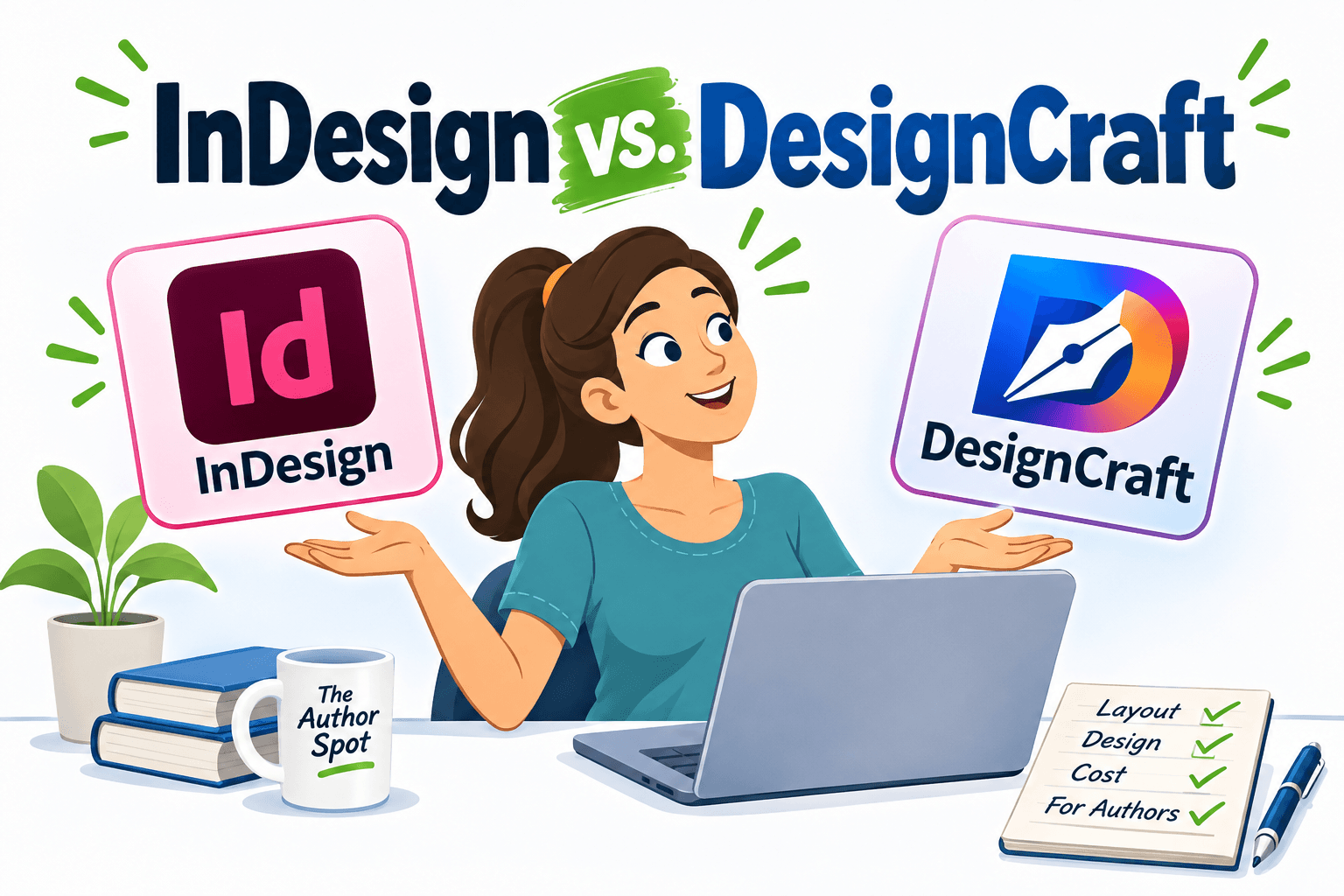
A developer used Claude AI to build ArtCraft, a collection of 13 free, open-source alternatives to Photoshop, Illustrator, Premiere Pro, InDesign, and more. But the big question for authors and independent publishers is simple: can DesignCraft really replace InDesign for book layout?
Using a VPN and seeing an error?
Click here to open and watch directly on YouTube.
Transcript:
Introduction: AI Takes on Adobe
Unless you’ve been living under a rock, you’ve probably heard this story.
A software developer, working with Claude, the AI, has built free alternatives to some of Adobe’s most popular applications.
Free. Open source. And aimed squarely at software that has dominated the creative world for decades.
Now, if you’re thinking this is a story for graphic designers and video editors, think again. It could matter a great deal to authors, editors, and independent publishers.
But there’s a catch. We’ll get to that, but first, let’s rewind for a second.
Backstory: When You Actually Owned Your Software
There was a time when you bought a piece of software, and it was yours. You paid once. You installed it. And you used it until you decided an upgrade was worth the money.
Adobe’s Creative Suite worked exactly that way. Photoshop for photos. Illustrator for graphics. Premiere Pro and After Effects for video. And InDesign for books and publication layout.
Then, in 2012, Adobe introduced Creative Cloud. By 2013, subscriptions were the main way forward.
So instead of buying the software, you rent it. Month after month after month.
Remember when you could buy software and use it until your computer died? Now your software might outlive your marriage, and you’ll still be making monthly payments.
And Adobe isn’t alone. Subscription pricing is everywhere these days.
Which brings us to the news.
Hot News: Meet ArtCraft
A project called ArtCraft has released a collection of thirteen open-source applications. And many of them are built as alternatives to programs you already know.
Let’s run through them.
On the Adobe side, PhotoCraft goes after Photoshop. VectorCraft takes on Illustrator. FilmCraft is the answer to Premiere Pro, and LightCraft aims at Lightroom. PdfCraft targets Acrobat, EffectCraft is the stand-in for After Effects, and DesignCraft is the clone of InDesign.
Then it gets broader. SoundCraft is up against Pro Tools. WordCraft takes on Microsoft Word. DeckCraft goes after PowerPoint, and GridCraft is the Excel alternative. CADCraft covers CAD software, and FigCraft is the one for Figma.
That’s an ambitious list.
Photoshop, InDesign, Premiere, and a whole lot of expensive software, all with potential free alternatives. And yes, the source code is public.
But before you go canceling subscriptions, hang on. There’s something you need to understand.
What Happened? One Developer and an AI Assistant
Meet Brandon Thomas. He’s the founder of ArtCraft.
Now, a project this size would normally call for a whole team of programmers. Thomas took a different route. He used Claude to help with much of the development.
The software is being written in a programming language called Rust. And no, we’re not going down that rabbit hole. What matters is this: it’s newly written software. This is not Adobe’s code with a fresh coat of paint.
Think about what that means.
Applications that used to take big teams and years of work are now being attempted with an AI assistant.
Does that mean AI can instantly recreate any commercial program? Of course not.
But it raises some fascinating questions about where software development is headed.
And it raises one very obvious question—isn’t copying software against the law?
Clean Room: Isn’t That Copying?
How do you reproduce what commercial software does without breaking copyright law?
The answer is something called a clean-room implementation.
Here’s the simple version. Picture two car companies. Both build cars with steering wheels, brakes, engines, and transmissions. Both cars do the same basic jobs. But that doesn’t mean one company stole the other’s protected designs.
Software can work the same way.
Developers study what an application does. Then they write their own code to do similar things. The goal is to get the useful features without copying the original’s protected code.
Now, let me be clear. Clean-room development is not a magic pass around intellectual property law. There are still legal lines.
ArtCraft describes its applications as independently implemented software. So that’s the claim.
Not the First Time: We’ve Seen This Before
And honestly, this isn’t the first time someone’s tried to build a free alternative to pricey software.
Remember ReactOS? It’s an ongoing effort to build an open-source operating system that’s compatible with many Windows applications.
Or Apache OpenOffice, a free office suite that grew out of the older StarOffice. And LibreOffice, another popular open-source suite, which started as a fork of OpenOffice.org.
And for you book people, there’s Scribus. It’s a free desktop publishing program for producing books, magazines, and other publications.
Now, not all of these were clean-room projects. But they prove a point. Free alternatives to commercial software have been around for years.
So what’s different this time? It’s how much artificial intelligence is helping build it.
And that’s what makes this story worth watching.
Spot’s T-Shirt Merch Promo
What Does This Mean for Authors and Publishers?
Let’s bring this home to The Author Spot, and the independent publishing world.
Think about what authors and publishers need software for. Writing and editing manuscripts. Designing covers. Formatting books for print. Producing e-books. Making promotional graphics and marketing videos.
Several ArtCraft applications aim at exactly those jobs.
But the one I’m most curious about is DesignCraft, the alternative to Adobe InDesign.
InDesign has been the industry standard for professional publication design for a long time. DesignCraft is aiming for similar functionality. Page layout and formatting. Paragraph and character styles. Handling multi-page publications. Importing and exporting publication files.
And here’s where it gets really interesting.
DesignCraft also hints at something bigger: using AI to help with the actual formatting and production of a book.
Imagine handing over a properly prepared manuscript and having the software do much of the tedious formatting work.
For independent authors, that could mean lower production costs. For small publishers, faster schedules. And for folks who aren’t exactly comfortable with technology, maybe, a simpler path to publishing.
And to the AI critics out there, you must admit, cutting publishing costs doesn’t sound so bad.
Reality Check: Hold Onto Your Socks!
Okay. Time for a reality check.
Before anyone rushes off to uninstall their Adobe apps, here’s the warning. These applications are brand new. They’re still experimental.
Some features may work well. Others may be incomplete, unreliable, or just not there yet.
And there’s a big difference between a software demo that impresses you and a dependable tool you can run a business on.
These programs haven’t yet earned the reliability and compatibility of their commercial counterparts.
Think of it this way. The paint is still tacky on this park bench. It looks inviting, but you might not want to sit down just yet.
Does that make the project unimportant? Not at all.
It just means we should judge these tools by what they can actually do, not by the excitement around the launch.
The Author Spot Puts DesignCraft to the Test
So here’s what we’re going to do about it.
Instead of just repeating the exciting news, we’re going to find out what this software can really do.
We’ll focus on DesignCraft, the InDesign alternative. And we’ll use a public-domain book to see whether it can produce a professionally formatted publication.
Now, here’s where things get especially interesting.
With AI assistance, it might be possible to automate much of the book layout and formatting process. Picture it. You hand over a manuscript, and AI handles a big chunk of the tedious production work.
Can it actually do that? That’s what we’re here to find out.
We’ll document the whole experiment. What works, what doesn’t, and where it needs to improve.
And if we find a practical way to automate book production, we’ll share it, so independent authors and publishers can benefit.
Closing: Is This a Turning Point?
So, has ArtCraft just changed the future of creative software?
Is this the beginning of the end for expensive desktop publishing programs?
Or is it an interesting experiment that isn’t quite ready for prime time?
Honestly? We don’t know yet.
But here’s what I do know. Artificial intelligence is changing how software gets built. And it could change how authors and publishers get their work done.
At The Author Spot, we care a lot about technology that lowers the cost and complexity of getting books into readers’ hands.
That’s why we’re putting DesignCraft to the test.
We’ll show you what happens. The wins, the failures, and maybe a surprise or two along the way. I hope you will follow us as we build this series.
I’m TJ Culler, and as we always say at The Author Spot: Go on and write. We’ll handle the tech.
 |
TJ Culler is an author, reader, and an adventurist. She loves working at The Author Spot as an Author Platform Specialist. Her hobbies include hiking, camping, and driving her Jeep in the great outdoors. After publishing her first book in 2017, TJ discovered what a daunting task an author platform really was. She now dedicates her time to helping authors who struggle with technology. |









Recent Comments